
 WhatsApp: 08024485178

WAEC 2026 CHEMISTRY PRACTICAL QUESTIONS AND ANSWERS
Gisthall.com is committed in providing waec candidates with assistance in ensuring sure success in the ongoing 2026 waec examination.
This post provides 2026 waec candidates with Waec 2026 Chemistry practical Questions and Answers.
Read this post carefully to find all that you seek.
Waec 2026 Chemistry Practical Questions and Answers.
The questions and answers for the 2026 waec chemistry practical will be posted shortly. KEEP REFRESHING THIS PAGE TO STAY UPDATED.
For more information, call or message GISTHALL TEAM on Whatsapp on 08024485178
Below are 2025 CHEMISTRY PRACTICAL PAST QUESTIONS you can study before the official questions for this year is released and uploaded by GISTHALL TEAM.
2025 WAEC CHEMISTRY PRACTICAL QUESTIONS AND ANSWERS PAST QUESTIONS
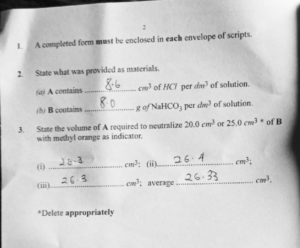
TEACHERS REPORT:
(2)
(a) 8.6
(b) 8.0
(3)
(i) 26.3
(ii) 26.4
(iii) 26. 3
Average 26.33
VERY IMPORTANT – PLEASE READ CAREFULLY
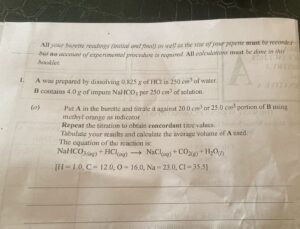
For Question 1:
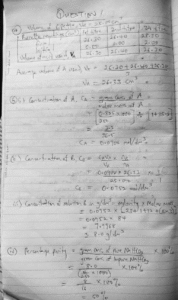
We used 26.33cm³ as our own school’s end point.
You must use your own school’s end point instead.
Anywhere you see 26.33cm³ in our answer, change it to your own and calculate again.
Example:
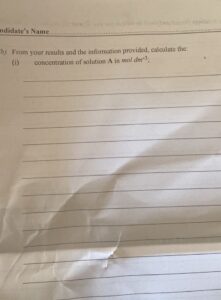
In 1bii, we used 26.33cm³ to get CB = 0.0952
→ You should use your school’s end point to get your own CB.
Then in 1biii, we used our 0.0952 to calculate and got 8.0
→ You must use your own CB from 1bii to get your own answer in 1biii.
In 1biv, we used the 8.0 from 1biii to get our final percentage
→ You must use your own value from 1biii to get your correct answer in 1biv.
Chemistry students should understand this.
If confused, kindly ask your Chemistry teacher for help.
NOTE:
If your school wants to use our end point (26.33), the Chemistry teacher must agree and submit something close to it… like 26.10, 26.20, 26.30, etc.
Number 1
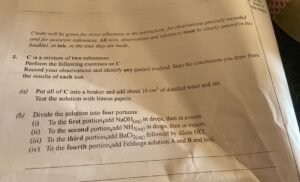
Number 3
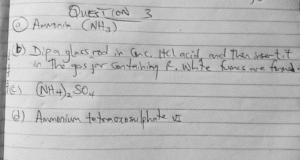
(3a)
Ammonia gas (NH₃).
(3b)
(PICK ANY ONE)
Dip a glass rod in concentrated hydrochloric acid and introduce it into the gas jar containing R; the formation of white fumes confirms the presence of ammonia gas.
OR
Expose the gas to hydrogen chloride (HCl) gas to observe formation of white fumes
OR
Introduce a glass rod soaked in concentrated HCl acid into the jar containing the gas; the appearance of dense white fumes confirms the presence of ammonia
(3c)
(NH₄)₂SO₄
(3d)
Ammonium tetraoxosulphate(VI)
For more information, call or message GISTHALL TEAM on Whatsapp on 08024485178

Be the first to comment